Ford’s strategies to cut costs on a $30,000 midsize electric pickup truck
DETROIT – As the electric vehicle market intensifies with competition from low-cost imports and domestic rivals, Ford Motor Company is aggressively pursuing cost reductions for its upcoming midsize EV pickup, aiming to hit an aggressive price point while maintaining profitability. Set for a 2027 launch, this vehicle represents a cornerstone of Ford’s Universal EV (UEV) platform, designed to democratize electric mobility without sacrificing range or utility. Drawing from a blend of innovative engineering, streamlined manufacturing, and strategic collaborations, Ford’s approach addresses the high costs of batteries and components that have plagued EV adoption. This strategy not only targets budget-conscious consumers but also positions Ford to compete globally, particularly against efficient Chinese manufacturers. With production ramping up at its revamped Louisville plant, the company is betting on these efficiencies to transform its EV lineup from premium offerings like the F-150 Lightning to more accessible models.
Engineering innovations driving down costs
At the heart of Ford’s cost-cutting playbook is a focus on vehicle efficiency, which allows for smaller, cheaper batteries—typically accounting for about 40% of an EV’s total cost. By making the truck lighter, more aerodynamic, and electrically optimized, Ford engineers have achieved a 15% improvement in overall efficiency, translating to an additional 50 miles of range on the same battery size as a comparable gas-powered pickup. This breakthrough stems from collaboration with former Formula 1 aerodynamic experts, who applied racing principles to reduce drag by 15% compared to traditional trucks.
Key design tweaks include zonal electrical architecture, consolidating functions into five main modules and slashing wiring by over 4,000 feet while shedding 22 pounds. Transitioning some systems to a 48-volt architecture further minimizes material use. Even small components like the charge port door have been reengineered for cost savings, exemplifying a “every part counts” mentality. Single-piece aluminum unicastings replace multiple welded parts, simplifying assembly and reducing weight. Power-folding mirrors, typically a premium feature, are standard on base trims using a shared motor to cut drag and costs.
To spur creativity, Ford implemented a bounty program, rewarding engineers for innovative savings in areas like mass reduction and part minimization. Rapid prototyping with 3D-printed “Lego-like” parts enables early wind tunnel testing, accelerating development and avoiding costly late-stage changes. In-house software for five electronic control units enhances portability and reduces reliance on suppliers. These efforts collectively shrink the battery size, directly lowering expenses while preserving over 300 miles of range.
Manufacturing efficiencies and platform optimization
Ford’s UEV platform is engineered for scalability, supporting not just the pickup but future sedans and SUVs, spreading development costs across models. It reduces overall parts by 20%, fasteners by 25%, and assembly workstations by 40% compared to traditional vehicles. This modular design boosts assembly speed by 15%, with potential for 40% gains as processes mature. Prepacked modules with integrated tools simplify worker tasks, further trimming labor expenses.
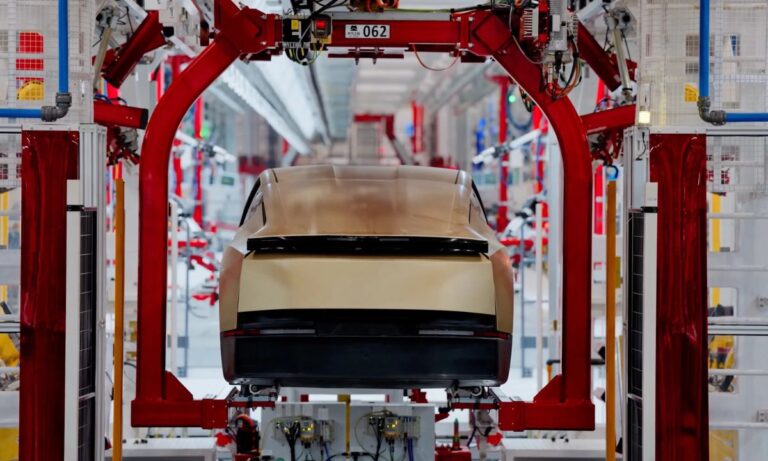
A $2 billion investment in the Louisville factory introduces a new production system, ditching conventional moving lines for more agile setups. Tesla-inspired tactics, like unicastings, streamline workflows and minimize errors. By focusing on profitability from day one, Ford avoids the losses seen in early EV rollouts, ensuring the truck’s economics align with mass-market appeal.
Strategic partnerships and talent acquisition
To accelerate innovation, Ford assembled a “skunkworks” team of 450 in Long Beach and 200 in Palo Alto, led by ex-Tesla veteran Alan Clarke. Recruits from Formula 1, Apple, Lucid, Rivian, and Tesla bring diverse expertise. The 2023 acquisition of startup Auto Motive Power bolsters power electronics capabilities.
Battery tech licensing from China’s CATL introduces affordable lithium iron phosphate (LFP) cells, slashing costs without compromising durability. These alliances enable Ford to leverage global supply chains while mitigating geopolitical risks through domestic assembly.
Market implications and future outlook
This cost-focused strategy positions the midsize EV pickup as a game-changer, offering more interior space than a Toyota RAV4, a frunk, and versatile bed options. By undercutting competitors, Ford aims to capture the growing demand for practical, eco-friendly trucks in urban and suburban settings. As EV adoption accelerates amid regulatory pressures, these efficiencies could help Ford regain momentum lost to rivals. Challenges remain, including supply chain volatility and consumer skepticism, but early indicators suggest this vehicle could redefine affordable electrification in the truck segment. With production on track, industry eyes are on Ford’s ability to deliver on these promises by 2027.