Ford Bronco fuse boxes: diagrams and specifications from 1990 to present
The Ford Bronco, an iconic off-road vehicle, has evolved its electrical systems over decades, with fuse boxes playing a crucial role in protecting circuits from overloads. From the rugged fourth-generation models of the early 1990s to the sophisticated sixth-generation revival, fuse configurations have adapted to increasing complexity in electronics, safety features, and power demands. Understanding these setups is essential for troubleshooting electrical issues, whether restoring a classic or maintaining a modern trail conqueror. This in-depth guide covers complete fuse diagrams, locations, amperage ratings, and protected components across key eras, drawing from official manuals and technical resources to ensure accuracy and comprehensiveness.
Evolution of fuse systems in Ford Bronco
Fuse boxes in the Ford Bronco have transitioned from simple blade-type setups in the 1990s to advanced power distribution modules incorporating relays and high-current maxi fuses. In the early models, fuses primarily safeguarded basic functions like lights and accessories, reflecting the Bronco’s utilitarian roots. By the 2020s, with the model’s rebirth, systems expanded to handle advanced driver aids, infotainment, and electrification elements, often featuring multiple boxes for better organization. This progression mirrors broader automotive trends toward modularity and diagnostics, making modern Broncos easier to service despite their tech-heavy nature. Key changes include the introduction of power distribution boxes under the hood and integration with body control modules for smarter power management.
Fuse diagrams for 1990-1991 models
The fourth-generation Ford Bronco (1987-1991) featured a straightforward fuse panel, typically located in the instrument panel to the left of the steering wheel, behind a removable cover. This era used ATO-style fuses and circuit breakers, focusing on essential vehicle operations without the extensive electronics of later years. No separate engine compartment box was standard, though some high-current items were protected via fusible links near the battery. Below is the full fuse assignment for the 1990 model, which is representative of 1991 as well—variations were minimal, often limited to optional equipment like 4WD or anti-lock brakes.
- Fuse 1 (15A): Stoplights, hazard lights, speed control.
- Fuse 4 (15A): Exterior lights, instrument panel illumination.
- Fuse 5 (15A): Turn signals, back-up lights, overdrive transmission (if equipped), roof map light.
- Fuse 6 (15A): Speed control, accessories, 4WD system.
- Fuse 8 (15A): Courtesy lights, dome lights, cargo light, glove box light.
- Fuse 9 (30A): Heater and A/C-heater blower.
- Fuse 10 (5A): Instrument illumination, clock dimming, radio display dimming.
- Fuse 10 (20A): Rear anti-lock brakes (if equipped).
- Fuse 11 (15A): Radio and clock illumination, headlight switch illumination.
- Circuit Breaker 12: Power door locks.
- Fuse 12 (25A): Transfer case control (if equipped).
- Circuit Breaker 14: Power windows.
- Fuse 14 (25A): Tailgate window.
- Fuse 15 (10A): Auxiliary fuel tank switch (if equipped).
- Fuse 16 (30A): Horn, cigarette lighter, speed control.
- Fuse 17 (5A): Instrument illumination, clock and radio display dimming.
- Fuse 17 (20A): Rear anti-lock brakes (if equipped).
- Fuse 18 (15A): Safety belt buzzer, warning indicators, tachometer, diesel glow plug control (if diesel), diesel indicators.
These fuses were arranged in a single block, with circuit breakers resetting automatically for high-draw items like windows. For diagnostics, owners often checked for corrosion in the panel, common in off-road environments where moisture could infiltrate.
Fuse diagrams for 1992-1996 models
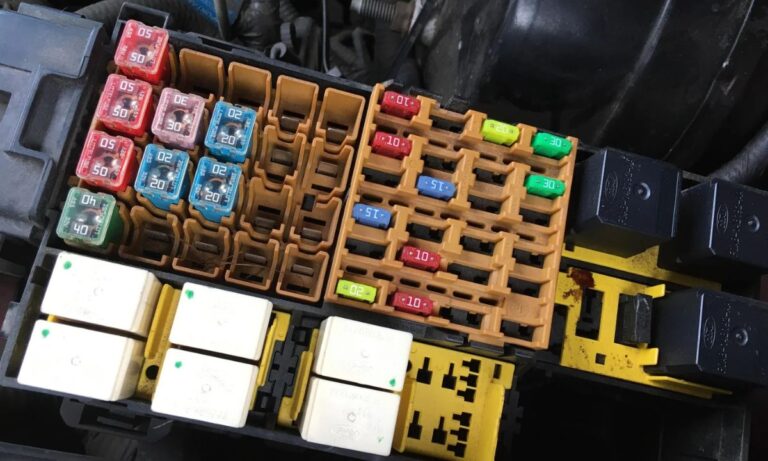
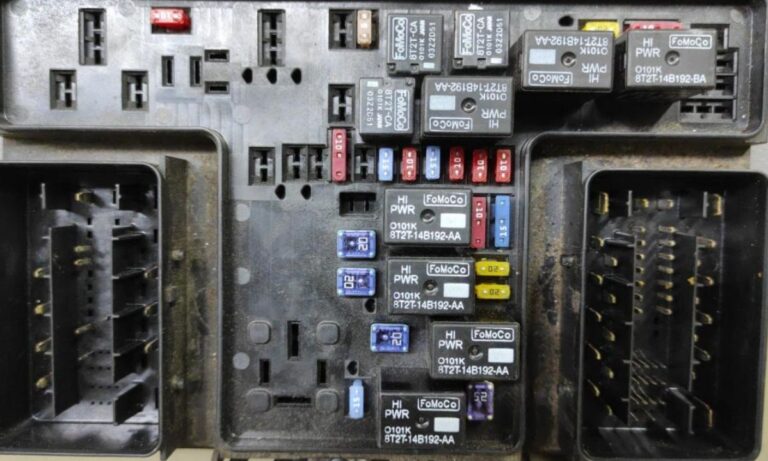
Entering the fifth generation, the Bronco adopted a more robust electrical architecture with two main fuse locations: the instrument panel fuse box behind a cover to the left of the steering wheel, and a power distribution box in the engine compartment on the driver’s side. This setup handled growing demands from features like air bags and electronic 4WD. Fuses included ATO types in the cabin and maxi fuses under the hood for higher amperage circuits. Relays were integrated into the power distribution box for functions like fuel pump and ABS. The configurations remained consistent across 1992-1996, with minor tweaks for options.
Instrument panel fuse box:
- Fuse/CB 1 (30A): Heater/air conditioner blower.
- Fuse/CB 2 (30A): Wiper/washer.
- Fuse/CB 3: Not used.
- Fuse/CB 4 (15A): Exterior lamps, instrument illumination, keyless entry, warning buzzer/chime module.
- Fuse/CB 5 (10A): Air bag restraint.
- Fuse/CB 6 (15A): Air conditioner clutch, remote/keyless entry.
- Fuse/CB 7 (15A): Rear window defrost, turn lamps.
- Fuse/CB 8 (15A): Courtesy lamps, electric outside mirrors, engine compartment lamp, keyless entry, speedometer, sun visor mirror illumination, warning buzzer/chime module.
- Fuse/CB 9 (25A): Power point.
- Fuse/CB 10 (4A): Instrument illumination.
- Fuse/CB 11 (15A): Radio, radio display dimmer.
- Fuse/CB 12 (20A circuit breaker): Electronic shift motor 4-wheel drive, power door locks, power lumbar, tailgate power window.
- Fuse/CB 13 (15A): Anti-lock brakes, brake shift interlock, speed control, stop/hazard lamps, stop sense for electronic engine control.
- Fuse/CB 14 (20A circuit breaker): Power window, tailgate power window (instrument panel switch).
- Fuse/CB 15: Not used.
- Fuse/CB 16 (15A): Cigarette lighter.
- Fuse/CB 17 (10A): Electronic transmission, gauges, tachometer, warning buzzer/chime module, warning indicators.
- Fuse/CB 18 (10A): Air bag restraint, automatic day/night mirror, brake shift interlock, electronic shift module 4-wheel drive, overhead console, speedometer.
Power distribution box (engine compartment):
- Fuse 1 (20A): Audio power.
- Fuse 2 (30A): Anti-lock brakes.
- Fuse 3 (30A): Headlamps flash-to-pass, daytime running lamps (Canada only), horn, speed control.
- Fuse 4 (25A): Trailer back-up lamps, trailer running lamps.
- Fuse 5 (15A): Anti-lock brakes, back-up lamps, daytime running lamp module (Canada only), speed control, trailer battery charge relay.
- Fuse 6 (10A): Trailer right-hand stop/turn lamp.
- Fuse 7 (10A): Trailer left-hand stop/turn lamp.
- Fuse 8 (30A maxi): Anti-lock brakes.
- Fuse 9 (20A maxi): Fuel pump relay coil, powertrain control system.
- Fuse 10 (20A maxi): Instrument panel fuses (15,18), starter relay coil.
- Fuse 11: Not used.
- Fuse 12: Diode for powertrain control system relay.
- Fuse 13 (50A maxi): Instrument panel fuses (5,9,13).
- Fuse 14 (30A maxi): Rear window defroster.
- Fuse 15 (50A maxi): Instrument panel fuses (1,7), power network box fuse 5.
- Fuse 16 (20A maxi): Fuel pump feed.
- Fuse 17 (50A maxi): Alternator charge lamp, instrument panel fuses (2,6,11,14,17), power network box fuse 22.
- Fuse 18 (30A maxi): Trailer battery charge.
- Fuse 19 (40A maxi): Headlamps.
- Fuse 20 (50A maxi): Instrument panel fuses (4,8,12,16).
- Fuse 21 (30A maxi): Trailer brake feed.
- Fuse 22 (20A maxi): Distributor pickup, ignition coil, powertrain control system relay coil, thick film integrated (TFI) module.
Relays in power distribution box:
- Relay 1: Powertrain control system.
- Relay 2: Fuel pump.
- Relay 3: Horn.
- Relay 4: Trailer tow running lamps.
- Relay 5: Anti-lock brake system (ABS) pump motor.
This dual-box design improved reliability for off-road use, where vibrations could loosen connections.
Fuse diagrams for 2021-present models
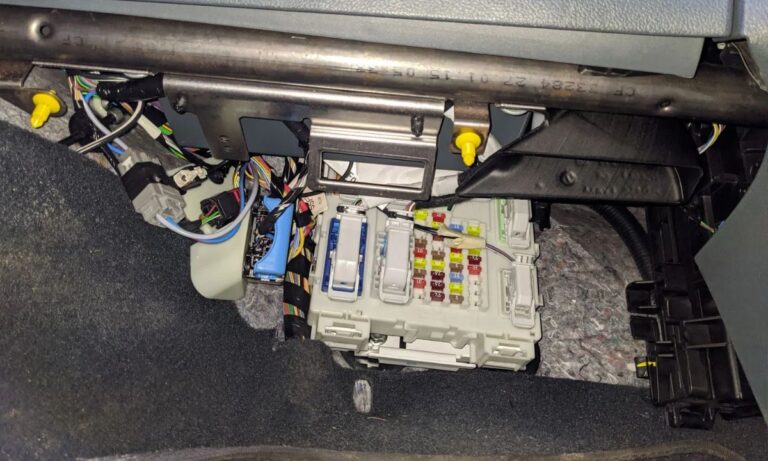
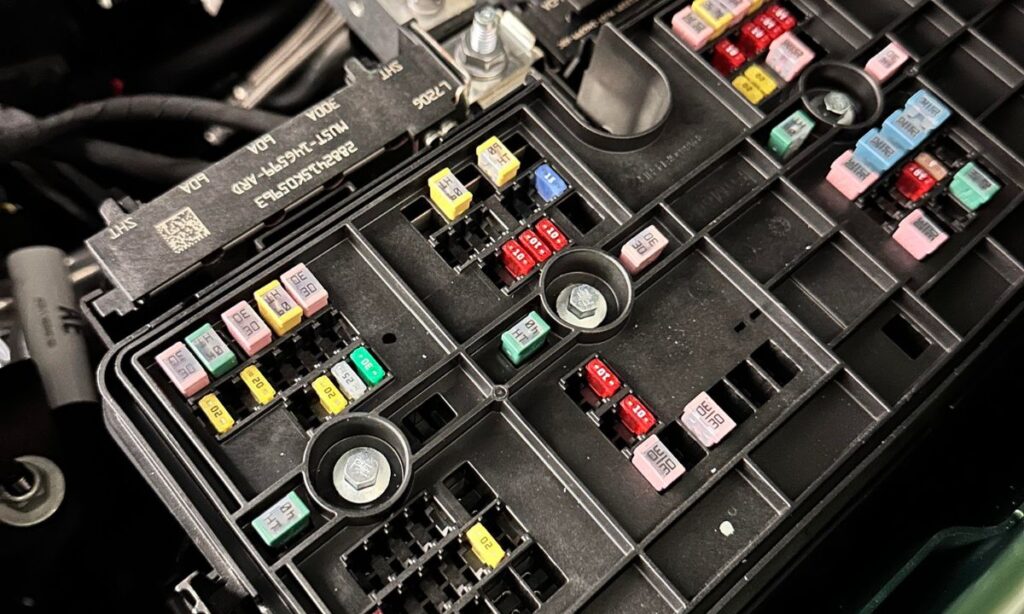
The sixth-generation Bronco, revived in 2021, boasts advanced fuse systems with two primary locations: the passenger compartment fuse box under the instrument panel below the steering wheel (behind a cover), and the engine compartment fuse box on the left side next to the battery. These incorporate micro fuses, mini fuses, and high-current cartridges, supporting features like adaptive lighting, trail cameras, and upfitter switches for customization. Configurations are similar from 2021 to 2026, with updates for new tech like enhanced infotainment. Power outlets (cigarette lighters) are protected by fuses 32, 33, and 34 in the engine box.
Passenger compartment fuse box:
- Fuse 1: Not used.
- Fuse 2 (10A): Power windows, DC/AC inverter.
- Fuse 3 (7.5A): Exterior mirrors, wireless charging module.
- Fuse 4 (20A): Not used (spare).
- Fuse 5: Not used.
- Fuse 6 (10A): Anti-theft alarm horn.
- Fuse 7 (10A): Not used.
- Fuse 8 (5A): Not used (spare).
- Fuse 9 (5A): Not used (spare).
- Fuse 10: Not used.
- Fuse 11: Not used.
- Fuse 12 (7.5A): Climate control, gateway module.
- Fuse 13 (7.5A): Steering column control module, instrument cluster module.
- Fuse 14 (15A): Not used (spare).
- Fuse 15 (15A): Not used (spare).
- Fuse 16: Not used.
- Fuse 17 (7.5A): Not used (spare).
- Fuse 18 (7.5A): Not used (spare).
- Fuse 19 (5A): Ignition switch, headlamps.
- Fuse 20 (5A): Telematics modem.
- Fuse 21 (5A): In-vehicle temperature and humidity sensor.
- Fuse 22 (5A): Not used.
- Fuse 23 (30A): Not used (spare).
- Fuse 24 (30A): Not used (spare).
- Fuse 25 (20A): Not used (spare).
- Fuse 26 (30A): Not used (spare).
- Fuse 27 (30A): Not used (spare).
- Fuse 28 (30A): Not used (spare).
- Fuse 29 (15A): Not used (spare).
- Fuse 30 (5A): Brake on-off switch.
- Fuse 31 (10A): Terrain management switch, integrated control panel switch, driveline and chassis controls switch panel, 12-inch center display, radio frequency receiver module.
- Fuse 32 (20A): Audio control module.
- Fuse 33: Not used.
- Fuse 34 (30A): Run/start relay.
- Fuse 35 (5A): Not used (spare).
- Fuse 36 (15A): Automatic high beam, image processing module A.
- Fuse 37 (20A): Auto-dimming interior mirror, parking assist control module, heated steering wheel.
- Fuse 38 (30A): Not used (circuit breaker).
Engine compartment fuse box:
- Fuse 1 (30A): Body control module – battery power in feed 1.
- Fuse 3 (30A): Body control module – battery power in feed 2.
- Fuse 4 (30A): Fuel pump.
- Fuse 6 (25A): Powertrain control module power.
- Fuse 7 (30A): Powertrain components.
- Fuse 8 (20A): Powertrain components.
- Fuse 9 (20A): Ignition coils.
- Fuse 13 (40A): Blower motor control module.
- Fuse 16 (10A): Rear windshield washer.
- Fuse 18 (30A): Starter motor.
- Fuse 21 (10A): Not used (spare).
- Fuse 22 (10A): 360-degree camera module.
- Fuse 23 (10A): Anti-lock brake system run-start feed.
- Fuse 24 (10A): Powertrain control module, power steering module.
- Fuse 25 (10A): Blind spot information system, rear view camera, adaptive cruise control, driveline control module.
- Fuse 26 (15A): Transmission control module.
- Fuse 28 (60A): Anti-lock brake system valves.
- Fuse 29 (60A): Anti-lock brake system pump.
- Fuse 30 (30A): Driver power seat.
- Fuse 31 (30A): Passenger power seat.
- Fuse 32 (20A): Auxiliary power point.
- Fuse 33 (20A): Auxiliary power point.
- Fuse 34 (20A): Auxiliary power point.
- Fuse 36 (40A): 150-watt DC/AC inverter.
- Fuse 38 (30A): Heated seat module.
- Fuse 42 (30A): Trailer brake control module.
- Fuse 44 (10A): Brake on-off switch.
- Fuse 46 (20A): SYNC module.
- Fuse 50 (40A): Heated rear windshield.
- Fuse 54 (40A): Driveline control module.
- Fuse 55 (30A): Trailer tow park lamp relay.
- Fuse 58 (20A): Trailer tow backup lamps.
- Fuse 60 (30A): Upfitter switch #1.
- Fuse 61 (15A): Upfitter switch #2.
- Fuse 62 (10A): Upfitter switch #3.
- Fuse 63 (10A): Upfitter switch #4.
- Fuse 64 (10A): Upfitter switch #5.
- Fuse 65 (10A): Upfitter switch #6.
- Fuse 66 (10A): Stability bar disconnect module.
- Fuse 69 (30A): Front windshield wiper.
- Fuse 71 (30A): Rear windshield wiper.
- Fuse 91 (40A): Trailer tow light module.
- Fuse 100 (20A): Left-hand headlamps.
- Fuse 101 (20A): Right-hand headlamps.
- Fuse 107 (30A): Trailer tow battery charge.
- Fuse 120 (10A): Fuel injectors (2.7L engine).
- Fuse 124 (5A): Not used (spare).
- Fuse 125 (10A): USB smart charger 1.
- Fuse 139 (5A): USB smart charger 2.
- Fuse 140 (5A): Not used (spare).
- Fuse 141 (5A): Not used (spare).
- Fuse 146 (20A): Amplifier.
- Fuse 158 (10A): Stability bar disconnect module run/start.
- Fuse 160 (10A): Smart data link control.
- Fuse 182 (60A): Driver door module.
- Fuse 183 (60A): Passenger door module.
- Fuse 202 (60A): Body control module B+.
- Fuse 210 (30A): Body control module start stop.
Modern Broncos benefit from over-the-air updates that can influence fuse-related diagnostics, but physical checks remain vital for off-grid adventures where electrical reliability is key.
Ford Bronco fuse systems encapsulate the vehicle’s journey from bare-bones adventurer to tech-savvy explorer, offering layers of protection that enhance durability and user experience across generations.