Honda CVT Earth Dreams Transmission: Complete Guide
The Honda CVT Earth Dreams transmission is one of the most refined continuously variable transmissions in the modern automotive market. Introduced as part of Honda’s broader Earth Dreams Technology initiative, this CVT was engineered to deliver exceptional fuel efficiency without sacrificing driving performance. Unlike conventional CVTs that have been criticized for sluggish response or excessive engine droning, Honda’s Earth Dreams CVT incorporates several proprietary innovations that set it apart from competing systems. This guide covers every technical aspect of the Honda Earth Dreams CVT, including specifications, common issues, fluid requirements, fault codes, and maintenance intervals.
What Is Honda Earth Dreams CVT Technology?
Honda launched the Earth Dreams Technology lineup in 2011, with the CVT variant debuting across multiple global markets from 2012 onward. The Earth Dreams CVT is a belt-and-pulley type continuously variable transmission designed to optimize the ratio between engine output and wheel torque across the entire RPM range. Key engineering goals included reducing internal friction, improving steel push-belt efficiency, and integrating a more responsive torque converter lockup system.
Core Technical Specifications
- Transmission type: Belt-driven CVT with steel push-belt
- Torque converter: Integrated lock-up clutch with early engagement capability
- Gear ratio spread: Approximately 6.0 (varies by application)
- Low ratio (maximum): Approximately 2.652
- High ratio (minimum): Approximately 0.441
- Final drive ratio: 4.357 (1.5L application), varies by model
- Reverse gear ratio: Approximately 1.536
- Compatible engines: 1.5L VTEC Turbo (L15B7), 1.8L i-VTEC (R18Z), 2.0L i-VTEC (R20A)
- Maximum input torque capacity: Up to 200 Nm depending on variant
- Fluid type: Honda HCF-2 CVT Fluid (mandatory)
- Fluid capacity: Approximately 5.8–6.5 liters depending on model
- Operating temperature range: -30°C to 150°C
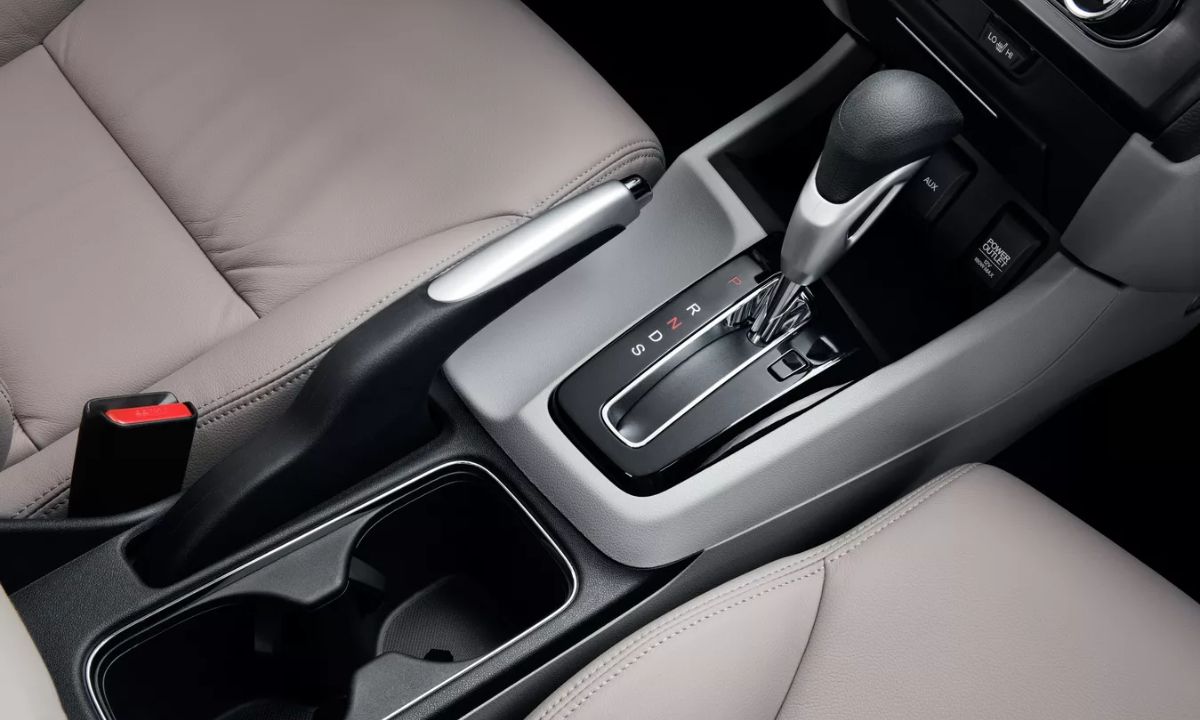
- Drive modes: D (Drive), S (Sport), L (Low), B (Engine Braking) on select models
Models Using Honda Earth Dreams CVT
- Honda Fit/Jazz (GK, 2013–2020): 1.5L naturally aspirated with Earth Dreams CVT
- Honda Civic (FC, 2016–2021): 1.5L VTEC Turbo paired with Earth Dreams CVT
- Honda HR-V (RU, 2014–2022): 1.8L i-VTEC with Earth Dreams CVT
- Honda CR-V (RW, 2017–2022): 1.5L VTEC Turbo with Earth Dreams CVT
- Honda Accord (CR, 2013–2017): 2.4L i-VTEC with Earth Dreams CVT
- Honda City (GM6, 2014–2020): 1.5L i-VTEC with Earth Dreams CVT
- Honda Jade (FR4, 2013–2020): 1.5L i-VTEC with Earth Dreams CVT
- Honda Shuttle (GP7, 2015–2022): 1.5L hybrid with Earth Dreams CVT integration
Honda Earth Dreams CVT Fluid Requirements
The Honda HCF-2 fluid is the only approved CVT fluid for Earth Dreams transmissions. Using any other fluid, including generic CVT fluids or fluids marketed as ‘Honda compatible,’ can cause irreversible belt and pulley damage, shuddering, and complete transmission failure.
- Fluid designation: Honda HCF-2 CVT Fluid
- Change interval (normal driving): Every 40,000 km or 3 years
- Change interval (severe driving): Every 20,000 km or 2 years
- Fluid color (new): Clear to light green
- Fluid color (degraded): Dark brown or black — indicates immediate change needed
- Drain plug torque: 39 N·m (29 lb-ft)
- Refill point: Through dipstick tube or overflow plug depending on model
Common OBD Fault Codes for Honda Earth Dreams CVT
- P0700 — Transmission Control System Malfunction: Generic TCM fault, requires further diagnosis of sub-codes
- P0720 — Output Speed Sensor Circuit Malfunction: Faulty OSS sensor or wiring issue
- P0730 — Incorrect Gear Ratio: Belt slip, pulley wear, or low fluid pressure
- P0740 — Torque Converter Clutch Circuit Malfunction: TCC solenoid failure or valve body issue
- P0745 — Pressure Control Solenoid ‘A’ Malfunction: Primary pressure solenoid fault
- P0750 — Shift Solenoid ‘A’ Malfunction: Solenoid failure or hydraulic blockage
- P0780 — Shift Malfunction: General shift performance fault often linked to belt slippage
- P1768 (Honda-specific) — CVT Speed Sensor Circuit Problem: Internal sensor failure
- P1794 (Honda-specific) — CVT Fluid Pressure Control Solenoid Malfunction: Requires solenoid or valve body replacement
- P17F0 (Honda-specific, Civic FC) — CVT Ratio Abnormality: Belt wear or pulley actuator fault
Known Issues and Technical Service Bulletins
- Shuddering at low speed: Affects primarily 2016–2018 Civic FC models; caused by torque converter lock-up engagement at low speeds; Honda issued TSB recommending HCF-2 fluid flush and TCM reprogramming
- Oil dilution in 1.5T models: Particularly in cold climates; gasoline entering crankcase can migrate into CVT fluid via seals; Honda extended warranty on affected units in certain markets
- Belt slip under hard acceleration: Reported in HR-V RU with worn belts after 120,000 km; characterized by sudden RPM spike without corresponding acceleration
- Jerky engagement from stop: Common in City GM6 models; resolved in most cases with updated TCM software and fresh HCF-2 fluid
- Overheating on grades: CR-V RW 2017–2019 with trailer towing reported CVT overheating warnings; Honda added an auxiliary cooler as a dealer-installed remedy
Maintenance and Inspection Intervals
- CVT fluid inspection: Every 10,000 km or annually
- CVT fluid replacement: Every 40,000 km under normal conditions
- CVT filter (internal strainer) inspection: Every 80,000 km
- Pulley and belt visual inspection: Every 100,000 km via specialist CVT inspection
- TCM software update: Check at every service visit, as Honda releases updates addressing shift logic and torque management
- Drive shaft seal inspection: Every 40,000 km to prevent fluid contamination