Ford EcoSport fuse box diagrams: complete guide for all generations
The Ford EcoSport is a compact crossover that has been popular worldwide since its global launch. Knowing the exact fuse box layout and assignments helps you quickly diagnose and fix common electrical issues such as non-working headlights, power windows, radio, air conditioning, horn, or fuel pump problems.
The EcoSport has two main generations with distinct fuse configurations:
- First Generation (2012–2017) — Pre-facelift and facelift models (also known as B515 platform in some markets).
- Second Generation (2018–2024) — Updated platform with revised electronics, new engines, and modern safety features.
Most models have two primary fuse boxes: one in the passenger compartment (usually behind the glove box or under the dashboard) and one in the engine compartment (near the battery). Some versions include a battery fuse box or additional sub-panels. Always replace a blown fuse with one of identical amperage. Disconnect the battery before working on high-current fuses.
First generation Ford EcoSport (2012–2017)
This generation was offered with 1.0L EcoBoost, 1.5L or 1.6L petrol, and 1.5L diesel engines. Fuse boxes are located as follows:
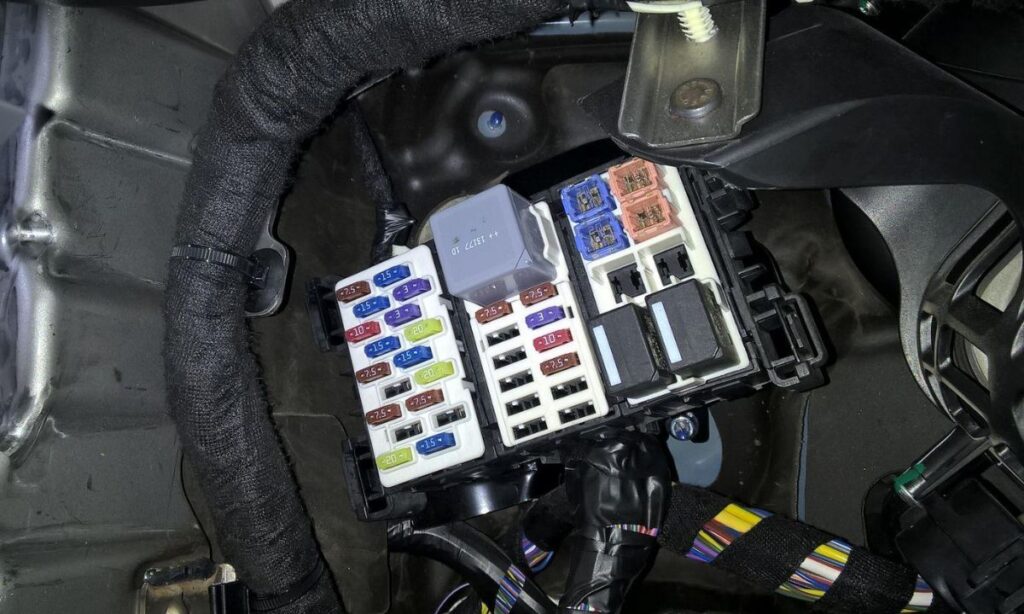
Passenger Compartment Fuse Box (Located behind the glove box — open glove box, remove shelf and side cover to access):
- 1: 10A — Ignition coil (petrol) / Glow plug control (diesel)
- 2: 20A — Rear window defogger / Heated mirrors
- 3: 15A — Fuel pump
- 4: 10A — Air conditioning clutch
- 5: 7.5A — Instrument cluster / Gauges
- 6: 7.5A — SRS airbag system
- 7: 10A — Daytime running lights (if equipped)
- 8: 15A — Horn
- 9: 20A — Driver power window
- 10: 20A — Passenger power window
- 11: 15A — Accessory power socket (cigarette lighter)
- 12: 10A — Back-up lights / Reversing lamp
- 13: 15A — Stop lights / Brake lights
- 14: 7.5A — Interior lights / Courtesy lamps
- 15: 10A — Audio system / Radio
- 16: 20A — Windshield wiper (front)
- 17: 15A — Rear wiper (if equipped)
- 18: 10A — Headlight low beam (right)
- 19: 10A — Headlight low beam (left)
- 20: 10A — Headlight high beam
- 21: 7.5A — Body control module / BCM
- 22: 10A — ABS / ESP module
- 23: 15A — Transmission control (automatic)
- Additional fuses for fog lights, alarm, and keyless entry systems (7.5A–15A)
Relays in Passenger Compartment: Ignition relay, accessory relay, rear defogger relay, power window relay.
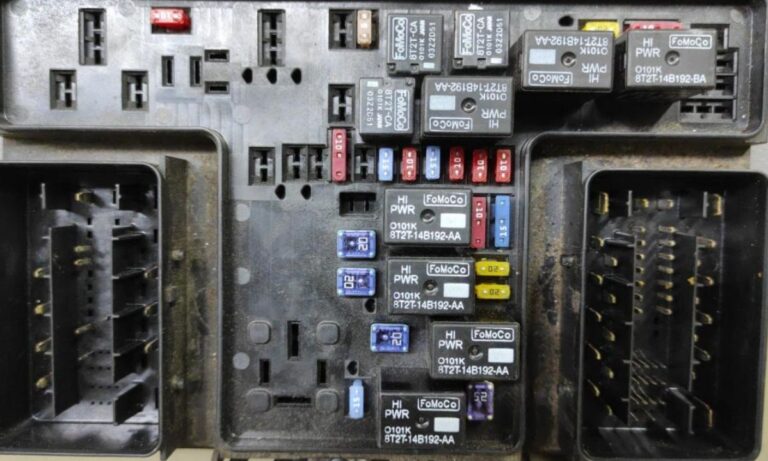
Engine Compartment Fuse Box (Located on the driver’s side near the battery):
- 1: 60A — Cooling fan (high speed)
- 2: 40A — Cooling fan (low speed)
- 3: 40A — ABS / ESP pump motor
- 4: 60A — Passenger compartment fuse box supply (battery)
- 5: 30A — Power door locks / Body control module
- 6: 40A — Blower motor (heater / A/C)
- 7: 30A — Starter motor
- 8: 20A — Fuel pump relay (diesel)
- 9: 15A — FI main relay (fuel injection)
- 10: 15A — Hazard lights / Turn signals
- 11: 10A — Alternator sense
- 12: 20A — Main fan
- 13: 30A — Headlight main relay
- 14: 10A — A/C clutch
- High-amperage main fuses: 100A or 120A Battery main fuse, 80A Ignition switch supply
Battery Fuse Box (Attached to the positive battery terminal in some markets):
- High-current protection for alternator, starter, and main power distribution.
Second generation Ford EcoSport (2018–2024)
This updated generation features a more modern interior, revised engines (including 1.0L EcoBoost 3-cylinder and 1.5L options), and improved safety systems. Fuse layouts were revised for better organization and additional electronic modules.
Passenger Compartment Fuse Box (Located on the right side below the glove box or behind the glove box — open glove box and release clips):
- F1: 7.5A — Restraints control module / Airbag
- F2: 5A — Humidity and in-car temperature sensor
- F3: 10A — Instrument cluster / Gauges
- F4: 7.5A — SRS / Occupant classification
- F5: 15A — Fuel pump
- F6: 10A — Air conditioning clutch
- F7: 10A — Headlight high beam (right)
- F8: 10A — Headlight high beam (left)
- F9: 10A — Headlight low beam (right)
- F10: 10A — Headlight low beam (left)
- F11: 10A — Interior lights / Courtesy lamps
- F12: 15A — Tail lights / License plate lights
- F13: 15A — Stop lights / Brake switch
- F14: 10A — Horn
- F15: 20A — Driver power window
- F16: 20A — Passenger power window
- F17: 15A — Accessory power socket (front)
- F18: 15A — Rear accessory power socket
- F19: 7.5A — Body control module / Keyless entry
- F20: 10A — Back-up camera / Reversing lights
- F21: 7.5A — Climate control module
- F22: 15A — Audio system / SYNC / Infotainment
- Additional low-amperage fuses for blind spot monitoring, lane keep assist, and USB charging ports.
Engine Compartment Fuse Box (Located on the driver’s side of the engine bay, near the battery):
- 1: 40A — Anti-lock braking system (ABS) / Electronic stability program valves
- 2: 60A — Cooling fan high speed
- 3: 30A — Cooling fan low speed
- 4: 40A — Blower motor relay (heater / A/C)
- 5: 60A — Passenger compartment fuse box supply (battery powered)
- 6: 30A — Power door locks (body control module)
- 7: 10A — Brake on/off switch
- 8: 20A — Moonroof (if equipped)
- 9: 15A — Rear washer / Wiper
- 10: 7.5A — A/C clutch relay
- 11: 5A — Power point relay
- 12: 20A — Fuel pump (petrol) or Glow plug (diesel)
- 13: 15A — FI main relay / Engine control module
- 14: 15A — Hazard / Turn signal lights
- 15: 30A — Starter motor
- 16: 40A — Headlight main relay
- 17: 15A — Front power point / Cigar lighter
- 18: 15A — Rear power point
- High-amperage fuses: 100A–150A main battery fuse, 80A ignition supply, 50A–60A for ABS pump and cooling fans.
Battery Fuse Box / Pre-Fuse Box (Attached directly to the battery positive terminal):
- Protects high-current circuits including alternator output, starter solenoid, and main power feed to both fuse boxes.
Important notes for all EcoSport models
- Cigarette Lighter / Power Outlet fuses are typically 15A or 20A and located either in the passenger compartment or engine compartment depending on the year.
- Headlights usually have separate fuses for low beam and high beam on each side.
- ABS / ESP and Airbag (SRS) systems have dedicated high-amperage and low-amperage protection.
- Diesel models include additional fuses for glow plugs and fuel heater.
- Automatic transmission and 4WD (AWD) variants have extra fuses for the transmission control module.
- Facelift models (around 2017–2018) introduced minor changes to fuse assignments for new infotainment and safety features.
For the most accurate information, always refer to the fuse box cover diagram or your specific owner’s manual, as slight variations exist between markets (Europe, India, Latin America, etc.), engine types (petrol vs diesel), and trim levels (Titanium, S, Ambiente).
Regularly check fuses during routine maintenance, especially if you notice intermittent electrical faults. A blown fuse is often the simplest and cheapest fix for many common problems in the Ford EcoSport. Using a fuse tester or multimeter makes diagnosis fast and reliable.
This complete reference covers the most common configurations found on roads today and should help you maintain and repair the electrical system of your EcoSport efficiently across its production years.