Toyota 4Runner N210 Fuses 2002-2009 Complete Guide
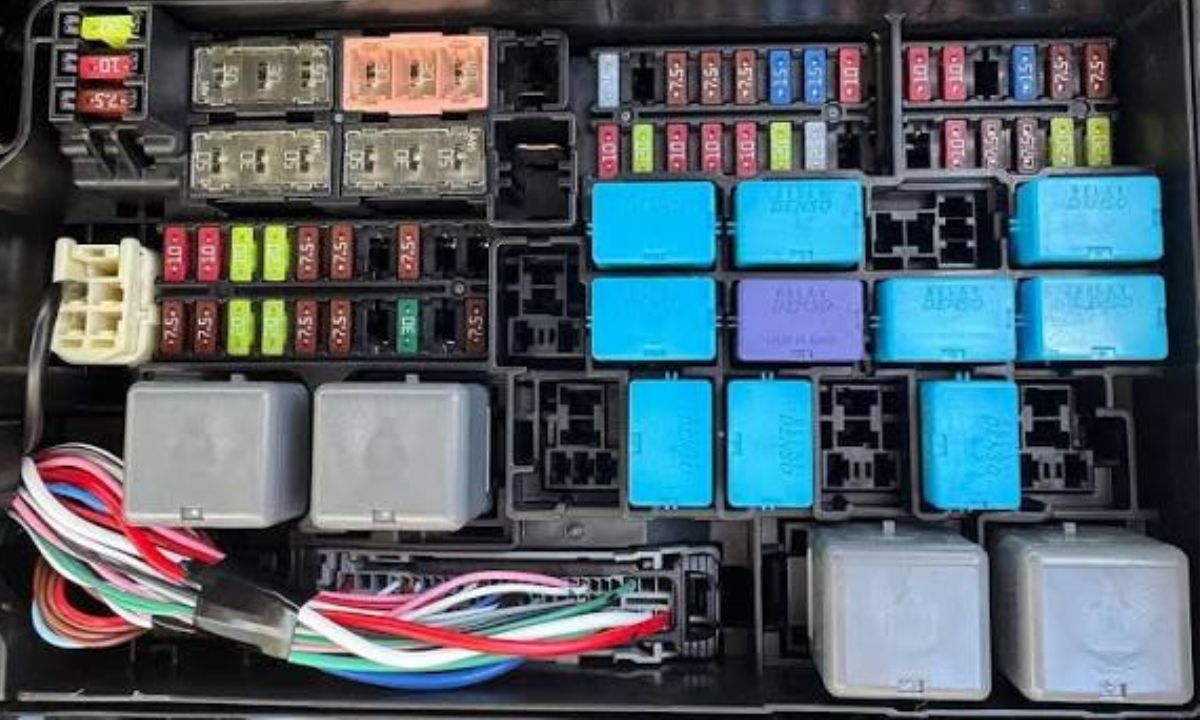
The Toyota 4Runner N210, produced from 2002 to 2009, uses a multi-box fuse and relay system to protect every electrical circuit in the vehicle. Knowing the exact location, amperage, and function of each fuse is essential for diagnosing electrical failures, replacing blown fuses correctly, and avoiding damage to sensitive components. This guide covers every fuse box in the N210 4Runner, including the engine compartment relay box, the instrument panel fuse box, and the additional relay blocks, with complete fuse listings for each.
Fuse Box Locations on the Toyota 4Runner N210
The N210 4Runner has two primary fuse and relay centers. The first is the Engine Compartment Fuse/Relay Box, located on the driver’s side of the engine bay near the battery. The second is the Instrument Panel Fuse Box, located under the driver’s side dashboard, accessible by opening a small cover panel to the left of the steering column. Some markets also include an additional relay block behind the glove box.
Engine Compartment Fuse and Relay Box
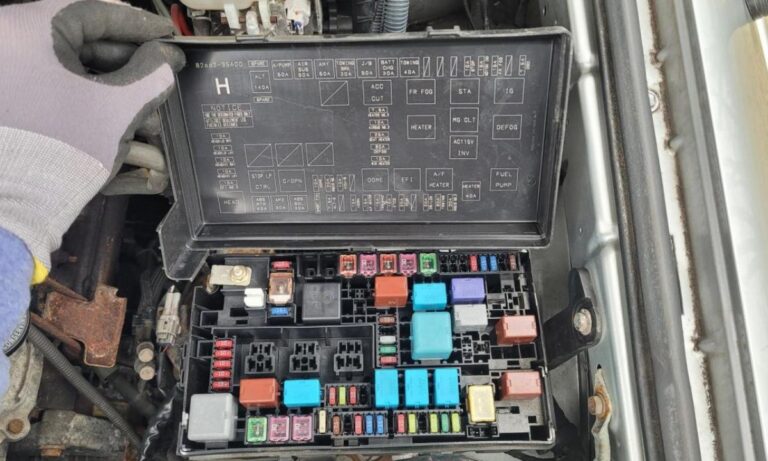
This box contains high-amperage fuses and relays protecting major vehicle systems. All fuses listed below are in the engine bay block:
- ALT Fuse – 120A – Alternator charge circuit protection
- AM1 Fuse – 80A – Main power supply to ignition switch and body electrical systems
- AM2 Fuse – 60A – Secondary main power supply for accessory and ignition circuits
- EFI Fuse – 15A – Engine control unit and fuel injection system
- MAIN Fuse – 40A – Main relay circuits, starting and charging systems
- ABS NO.1 Fuse – 40A – ABS actuator motor pump power supply
- ABS NO.2 Fuse – 30A – ABS ECU and solenoid valve circuit
- COOLING FAN Fuse – 40A – Electric radiator cooling fan motor
- HTR Fuse – 40A – Blower motor for heating and air conditioning system
- RDI Fuse – 30A – Four-wheel drive transfer case actuator and differential lock
- IGN Fuse – 30A – Ignition system power distribution
- A/C Fuse – 7.5A – Air conditioning compressor clutch relay circuit
- ETCS Fuse – 7.5A – Electronic throttle control system
- ST Fuse – 7.5A – Starter motor relay signal circuit
Instrument Panel Fuse Box (Under Dashboard)
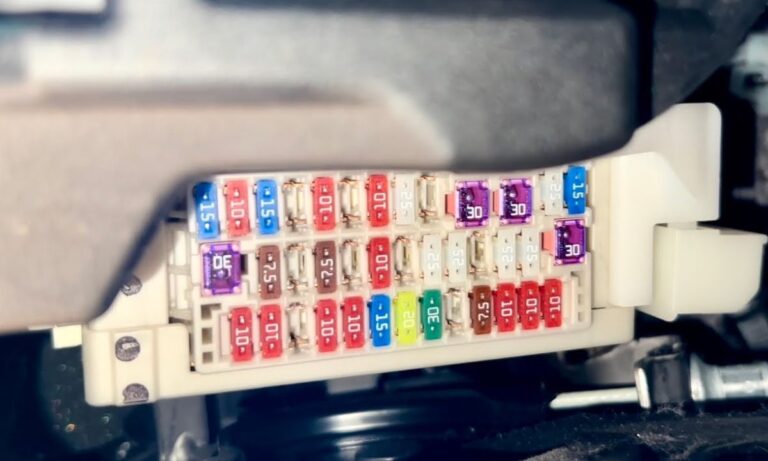
This is the secondary fuse block located on the driver’s side lower dashboard. It contains lower-amperage fuses for interior and accessory circuits:
- Fuse 1 – WIPER 20A – Front windshield wiper motor and washer pump
- Fuse 2 – TAIL 15A – Taillights, parking lights, license plate light
- Fuse 3 – STOP 15A – Brake light circuit and brake lamp switch
- Fuse 4 – TURN 10A – Turn signal indicator lights front and rear
- Fuse 5 – HORN 10A – Horn and relay circuit
- Fuse 6 – DOME 7.5A – Interior dome light, map lights, door courtesy lights
- Fuse 7 – RADIO 10A – Audio head unit, antenna amplifier
- Fuse 8 – CIG 15A – Cigarette lighter socket and 12V accessory outlet
- Fuse 9 – P/W 30A – Power window motor circuits all doors
- Fuse 10 – MIRROR 10A – Electrically adjustable and heated door mirrors
- Fuse 11 – ECU-B 7.5A – Engine ECU memory and keep-alive power
- Fuse 12 – OBD 7.5A – On-board diagnostics port power supply
- Fuse 13 – SEAT HTR 20A – Heated front and rear seat elements (where fitted)
- Fuse 14 – DEF 30A – Rear window defogger heating element
- Fuse 15 – FOG 15A – Front fog lights (where fitted)
- Fuse 16 – CRUISE 10A – Cruise control module and actuator
- Fuse 17 – DOOR LOCK 20A – Central door locking actuators and keyless entry relay
- Fuse 18 – GAUGE 10A – Instrument cluster, fuel gauge, temperature gauge
- Fuse 19 – A/C 10A – Air conditioning control panel and blower motor relay
- Fuse 20 – POWER POINT 15A – Rear 12V accessory power outlet
- Fuse 21 – 4WD 10A – Four-wheel drive control module and indicator
- Fuse 22 – SPORT 10A – Sport mode selector switch (V8 models with TEMS)
- Fuse 23 – TRAC 10A – Traction control system and VSC indicator circuit
- Fuse 24 – AM2 10A – Accessory relay for ignition-switched circuits
- Fuse 25 – SUNROOF 20A – Power sunroof motor and tilt mechanism (where fitted)
Identifying and Replacing a Blown Fuse
To identify a blown fuse in the N210 4Runner, remove the fuse using the fuse puller tool stored inside the instrument panel fuse box cover. Inspect the metallic strip inside the fuse body — if it is broken or appears burned, the fuse has blown. Always replace with a fuse of identical amperage rating. Installing a higher-rated fuse can cause wiring harness fires and void insurance claims.
Common Electrical Issues Traced to Fuses on the N210 4Runner
- Power windows inoperative on all doors – Check P/W 30A fuse in instrument panel box
- No brake lights – Inspect STOP 15A fuse and brake light switch integrity
- Rear defogger not working – DEF 30A fuse and defogger relay in engine bay box
- OBD scanner not powering on – OBD 7.5A fuse in instrument panel box
- Central locking failure – DOOR LOCK 20A fuse combined with keyless entry module
- Check engine light with EFI-related codes – EFI 15A fuse in engine compartment box
- ABS warning light on with no activation – ABS NO.1 40A or ABS NO.2 30A fuses
Fuse Amperage Types Used in the N210 4Runner
The 4Runner N210 uses standard blade-type fuses (ATC/ATO) for the instrument panel box and large blade-type (MAXI/PAL) fuses for the engine compartment block. Always carry a spare fuse assortment of the following ratings when off-roading or travelling long distance:
- 7.5A – Yellow mini blade
- 10A – Red mini or standard blade
- 15A – Blue standard blade
- 20A – Yellow standard blade
- 25A – Natural/clear standard blade
- 30A – Green standard blade
- 40A – Orange MAXI blade