Peugeot Engine Oil: PSA Specifications Explained for PureTech, BlueHDi, and Older Engines
Peugeot uses the PSA oil approval system — a set of internal codes that go beyond generic ACEA or API classifications. Using an oil that meets ACEA C2 but not the correct PSA code is not equivalent, and on the 1.2 PureTech engine the consequences are serious: incorrect oil chemistry causes the rubber timing belt — which runs submerged in oil — to swell, crack, and shed particles that block the oil pump. Since the PureTech is the most common engine in the current Peugeot range, getting this right matters for the majority of owners.
1.2 PureTech — B71 2312
The 1.2 PureTech turbocharged and naturally aspirated engines — found in the 208, 2008, 308, 3008, 5008, Rifter, and Partner — require oil meeting PSA B71 2312. This specification was developed specifically for the PureTech family to handle the belt-in-oil timing system. The grade is typically 5W-30 full synthetic, though some recent variants additionally accept 0W-20 meeting the same PSA code.
The PSA B71 2312 standard applies to all Peugeot and Citroën vehicles equipped with BlueHDi diesel engines fitted with SCR systems, and additionally covers engines with the most severe thermal constraints. For the PureTech petrol engine specifically, the standard ensures the oil chemistry does not damage the rubber timing belt material.
Do not use:
- Any oil meeting only ACEA C2 without explicit B71 2312 approval on the label
- 10W-40 or 5W-40 oils — too thick for the belt-in-oil system
- Semi-synthetic or mineral oil of any grade
All 1.2 PureTech wetbelt engines, regardless of power output, emission class, or build year, should use 5W-30. Where a dealer supplies 0W-20 for a newer PureTech variant, confirm this carries B71 2312 approval — not a different PSA code.
Capacity for the 1.2 PureTech: approximately 3.5–3.8 litres with filter.
1.5 and 1.6 BlueHDi Diesel — B71 2290
Current Peugeot diesel engines — the 1.5 BlueHDi (DV5) and 1.6 BlueHDi (DV6) — require PSA B71 2290, a low-SAPS 5W-30 oil meeting ACEA C2 or C3. B71 2290 is a low-SAPS oil intended for engines with diesel particulate filters and Euro 5 emission standards. The DPF system cannot tolerate high-ash oil — using a standard diesel oil with Full SAPS chemistry clogs the filter prematurely and shortens its service life significantly.
Mobil 1 ESP Formula P 5W-30 is approved by Stellantis as FPW9.55535/03, PSA B71 2290, and PSA B71 2297 — suitable for DV5R diesel engines in the 1.5L BlueHDi.
Capacity for the 1.5 BlueHDi: approximately 4.0–4.5 litres with filter. Capacity for the 1.6 BlueHDi: approximately 4.5–5.0 litres with filter.
2.0 BlueHDi Diesel — B71 2312
The 2.0 BlueHDi (DW10) in the 3008, 5008, and Expert van requires PSA B71 2312, typically in 0W-30. All 2016 3008 1.6 BlueHDi engines carry a recommendation of 0W-30 B71 2312. This applies equally to the 2.0L variant. Where 0W-30 B71 2312 is not available locally, 5W-30 B71 2290 is the PSA-approved substitute for a single service.
Capacity for the 2.0 BlueHDi: approximately 5.5–6.0 litres with filter.
Older Petrol Engines — B71 2296
Pre-2010 Peugeot petrol engines — including the 1.4 TU, 1.6 TU5, and 2.0 EW10 — use PSA B71 2296, a 5W-40 or 5W-30 full synthetic meeting ACEA A3/B4. B71 2296 is a general specification with main requirements of ACEA A3/B4 with additional PSA tests. This is the standard specification for petrol engines before the PureTech era and remains relevant for the large number of pre-2012 Peugeot models still in service.
1.6 THP / EP6 Turbocharged Petrol — B71 2296 or B71 2298
The 1.6 THP (EP6) engine — used in the 207, 307, 308, 3008, RCZ, and 508 from approximately 2007 to 2019 — requires PSA B71 2296 or B71 2298, typically 5W-40 full synthetic meeting ACEA A3/B4. This engine was co-developed with BMW and is the same unit as the Mini/BMW N16 family. It is notably sensitive to oil quality — chain stretch, timing chain rattle, and oil consumption are common on higher-mileage examples that received extended service intervals or incorrect oil grades.
Do not use 5W-30 Low-SAPS (B71 2290) in the THP — this is a diesel specification and provides insufficient protection for the THP’s high-revving turbocharged design.
Capacity: approximately 4.5–5.0 litres with filter.
Older HDi Diesel — DW10 and DV6 pre-BlueHDi
Pre-2014 Peugeot diesel engines without DPF systems — the DW10 2.0 HDi and DV6 1.6 HDi in older 307, 308, 407, and 607 — accept 5W-40 or 5W-30 meeting ACEA B3/B4 under PSA B71 2296. Since these engines predate DPF fitment, they are not sensitive to SAPS content in the same way as current BlueHDi units — a standard ACEA A3/B4 oil is acceptable.
For DPF-equipped HDi engines from 2008 onward (Euro 5), B71 2290 Low-SAPS 5W-30 applies, the same as current BlueHDi models.
Capacity varies: approximately 4.5–5.5 litres with filter depending on variant.
How to Read the Label
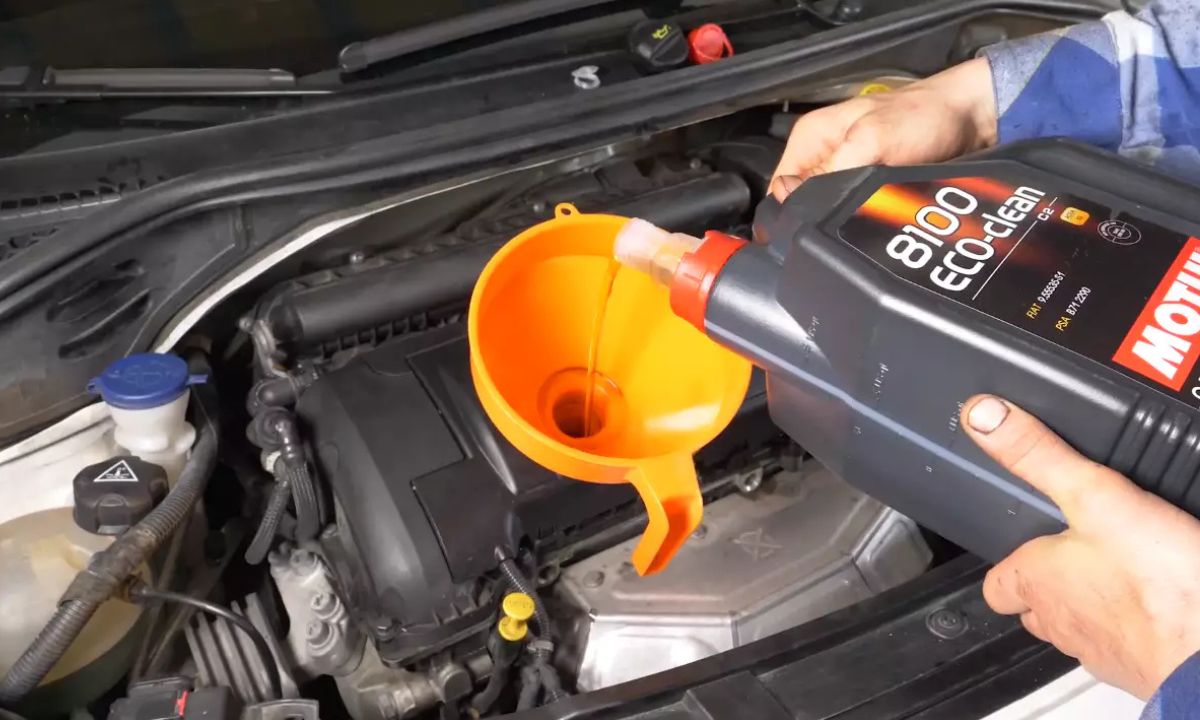
When purchasing oil for any Peugeot, look for the PSA approval code printed explicitly on the label:
- B71 2312 — PureTech petrol and 2.0 BlueHDi diesel
- B71 2290 — 1.5 and 1.6 BlueHDi diesel
- B71 2296 — older petrol engines pre-2010
The ACEA rating alone is not sufficient — B71 2312 must appear by name. Brands with confirmed PSA-approved products include Total Quartz, Castrol EDGE, Mobil 1 ESP, Shell Helix Ultra, and Motul Specific.
Change Intervals
Peugeot’s official interval for most current petrol models is 20,000 km or 2 years. However, for PureTech engines many independent specialists recommend 10,000 km or 1 year to reduce belt wear risk — particularly on pre-2022 engines with the original belt compound. For diesel models, 15,000–20,000 km or 1 year applies under normal driving conditions.