
Omoda Engine Oil: What the 1.5T, 1.6T, and 2.0T Engines Actually Need
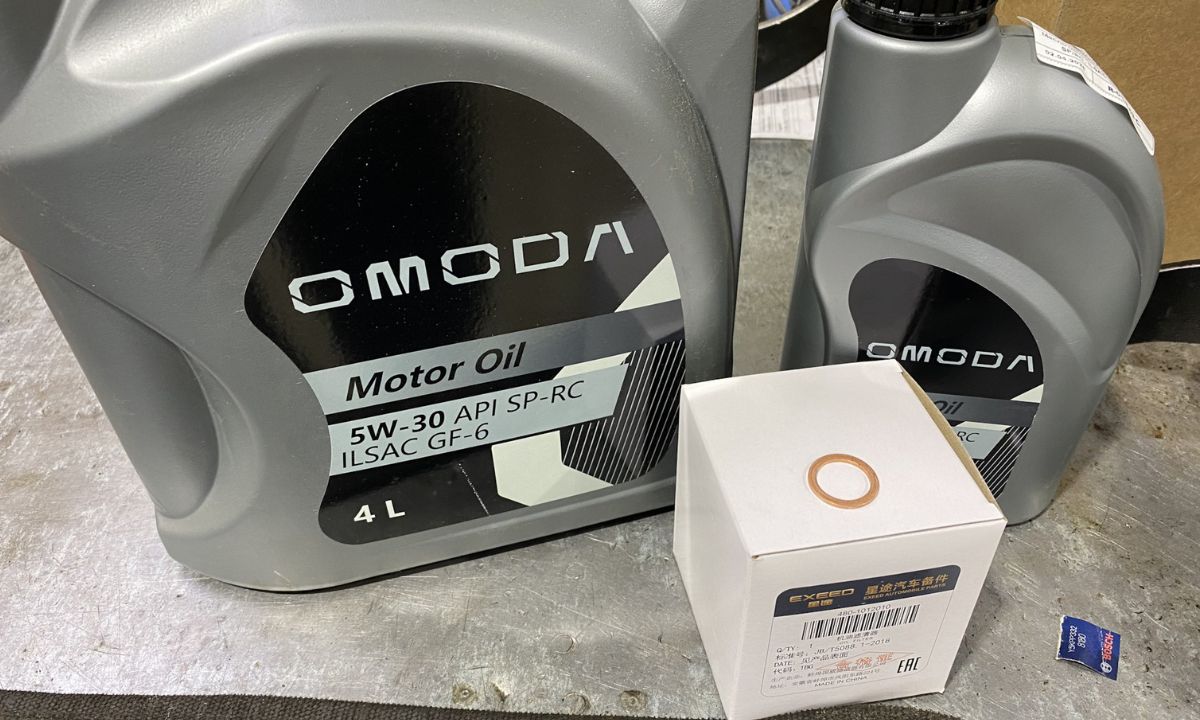
Omoda is a Chery sub-brand, and the engines across the Omoda 5, 7, and 9 share their technical foundation with Chery’s wider platform. Since all current Omoda petrol engines are turbocharged, oil specification compliance matters more than it would on a naturally aspirated unit — turbochargers run at temperatures that degrade inadequate oil faster, and the variable valve timing systems are sensitive to oil cleanliness and viscosity consistency.
Naturally Aspirated and 1.5T Turbocharged Petrol
The 1.5T engine appears in the Omoda 5 base variants in several markets. Chery recommends 0W-20 or 5W-30 full synthetic, meeting API SP or SN classification. Both grades are acceptable, however the choice depends on conditions:
- 0W-20 — primary recommendation. Improves cold-start flow and reduces friction at operating temperature, contributing to the fuel economy figures Chery publishes.
- 5W-30 — acceptable alternative in markets with sustained high ambient temperatures or for owners who drive aggressively or tow.
Do not use mineral or semi-synthetic oil on any turbocharged Omoda engine. The turbocharger retains heat after shutdown and continues exposing the oil to high temperatures without active cooling — synthetic oil withstands this significantly better than conventional alternatives.
Capacity: approximately 4.0–4.2 litres with filter.
1.6T Turbocharged Petrol
The 1.6T Kunpeng SQRF4J16 is the primary engine in the Omoda 5 across most markets. The specification is the same as the 1.5T — 0W-20 or 5W-30 full synthetic meeting API SP or SN — however the slightly higher output and turbocharger size make 5W-30 the more conservative choice in hot climates.
Ravenol’s vehicle-specific data for Chery/Jaecoo vehicles with this engine lists oils meeting VW 502.00/505.00 and MB 229.5 approvals as suitable — both are ACEA A3/B4 5W-30 full synthetics.
Capacity: approximately 4.5–5.0 litres with filter.
2.0T Turbocharged Petrol
The 2.0T TGDI engine in the Omoda 7 and Omoda 9 petrol runs higher thermal loads than the smaller units. The recommended grade is 5W-30 full synthetic API SP as the primary choice, with 0W-20 acceptable where 5W-30 is unavailable.
Capacity: approximately 5.0–5.5 litres with filter.
Hybrid and PHEV Variants
Omoda’s hybrid powertrains — the 1.5T SHS-H full hybrid in the Omoda 5 and the 2.0T SHS-P plug-in hybrid in the Omoda 9 — use the same oil specification as their equivalent petrol engines. However, the change interval is more critical on these variants.
Since the petrol engine runs in short duty cycles — starting cold, running briefly, then shutting down while the electric drive handles propulsion — fuel accumulates in the oil faster than mileage suggests. Therefore:
- 1.5T SHS-H — 5W-30 full synthetic preferred; change every 7,500 km or 6 months regardless of what the service reminder shows
- 2.0T SHS-P — 5W-30 full synthetic; same 7,500 km or 6 month interval
- The electric drive components use a separate DHT fluid — not interchangeable with engine oil
What to Look for on the Label
When purchasing oil for any Omoda model, the label must show:
- API SP (current standard, preferred) or API SN
- Correct viscosity: 0W-20 or 5W-30 for 1.5T and 1.6T; 5W-30 preferred for 2.0T
- Full synthetic — not synthetic blend or mineral
Change Intervals
Omoda recommends 10,000 km or 12 months for standard petrol models. However, independent specialists in hot-climate markets — UAE, South Africa, Malaysia — recommend 7,500 km or 6 months due to higher operating temperatures accelerating oil degradation. For hybrid and PHEV variants, 7,500 km or 6 months applies regardless of market. Omoda’s 10-year engine warranty requires servicing at approved dealers using Omoda-approved oil — owners who service independently should retain receipts showing the correct grade.