
Porsche Dashboard Warning Lights: What Every Symbol Means
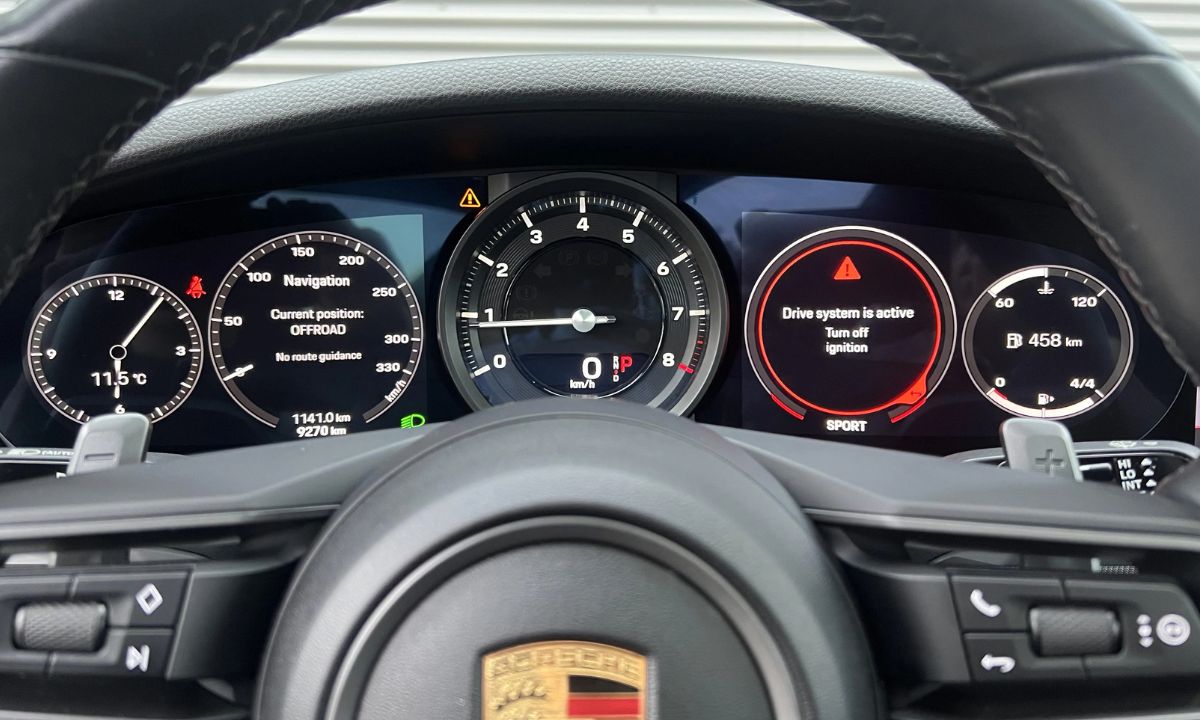
Porsche uses a colour-coded warning system across all current models — 911, Taycan, Macan, Cayenne, Panamera, 718 Boxster and Cayman. Red means stop or act immediately. Yellow or amber means schedule service or investigation. Green and blue confirm active systems. Since Porsche’s instrument cluster displays both traditional icons and text messages simultaneously on most models, the combination of icon and message provides more context than either one alone.
Red Warning Lights — Stop Immediately
Red lights on a Porsche require immediate action. Continuing to drive with most red warnings active risks serious mechanical damage or personal injury.
Low Oil Pressure — A small oil can with a drop falling from its spout, red. The engine is not receiving adequate lubrication. Pull over immediately and switch off the engine. Check the oil level before restarting. Since the flat-six in the 911 and the V8 in the Cayenne can sustain severe bearing damage within minutes at low oil pressure, do not drive even a short distance with this light active.
Engine Coolant Temperature — A thermometer submerged in wavy liquid, red. The engine is overheating or coolant level is critically low. Stop the vehicle, switch off the engine, and allow it to cool before opening the bonnet. Do not remove the coolant cap while hot, because the pressurised system can cause burns.
Battery / Charging System — A rectangle with a plus sign on one end and minus on the other — the standard battery outline, red. The alternator is not charging or there is an electrical fault. Since electrical systems begin failing as battery reserve depletes, drive directly to a service point rather than waiting.
Brake System — A circle with an exclamation mark inside, sometimes with the word BRAKE, red. If the parking brake is released and the light remains on, brake fluid is critically low or a hydraulic fault exists. Do not continue driving until the cause is identified.
Airbag / SRS — A seated figure with a large circle inflated in front of them, red. A fault exists in the supplemental restraint system. Because airbags may not deploy in a collision — or may deploy unexpectedly — this requires immediate diagnosis at an authorised Porsche centre.
Master Warning / Red Exclamation Mark — A red exclamation mark, sometimes inside a triangle. This is a master fault indicator that corresponds to multiple systems requiring immediate attention. The causes vary across models, however in all cases service is required urgently. On the Cayenne and Macan, this light is accompanied by a specific text message on the PCM screen describing the fault.
Porsche Stability Management (PSM) Fault — The letters PSM in red, or a car with wavy lines in red. A serious fault in the stability management system has been detected and the system is disabled. Since PSM provides both traction control and stability intervention, this significantly affects handling in emergency situations. Seek service before driving in adverse conditions.
Steering Lock — A padlock on a steering wheel outline, red. The steering lock has engaged unexpectedly. Have the fault remedied at an authorised Porsche dealer immediately — do not attempt to drive with this light active.
Yellow and Amber Warning Lights — Schedule Service
Yellow lights indicate faults that allow continued driving in most cases, however they should not be ignored or postponed for extended periods.
Check Engine (MIL) — An engine block outline, yellow. The engine management system has logged a fault covering emissions, fuel, ignition, or sensors. A steady light allows continued driving — schedule a diagnostic scan. A flashing check engine light indicates an active misfire that can damage the catalytic converter. Reduce load and speed immediately and seek service the same day.
ABS — The letters ABS inside a circle with a ring around it, yellow. The antilock brake system has a fault and is therefore disabled. Standard braking still functions, however wheels may lock under hard braking. Avoid aggressive braking until repaired.
PSM Active / Off — A car with wavy lines beneath it, yellow. When flashing, PSM is actively intervening — normal behaviour on slippery surfaces or during spirited driving. When steady yellow, the system has been manually switched off or has a fault. Since PSM off significantly affects handling at the limit, reactivate it for normal road use.
Tire Pressure (TPMS) — A cross-section of a tire resembling a horseshoe shape with an exclamation mark inside, yellow. One or more tires are significantly underinflated. Check all four tires and inflate to the pressure shown on the driver’s door jamb. On the 911, correct pressures differ significantly between front and rear axles — always use the correct values for each. If pressure is correct and the light remains on, recalibrate the TPMS through the PCM settings menu.
Service Due — A spanner or wrench icon, yellow, sometimes accompanied by a mileage countdown in the instrument cluster. Scheduled maintenance is due. On the Taycan and Cayenne E-Hybrid, a spanner with a lightning bolt additionally indicates the hybrid system requires servicing.
Fuel Level Low — A fuel pump icon with an arrow pointing downward, yellow. Fuel level is approaching empty. On the 911, the range-to-empty figure shown in the instrument cluster is more reliable than the fuel gauge at very low levels.
AWD / PTM Fault — A car with lines indicating all four driven wheels, yellow. Found mainly in AWD-equipped models — Cayenne, Macan, 911 Carrera 4. A yellow AWD light suggests an AWD fault or a shifting fault has occurred. If the vehicle has been used off-road recently, this may also indicate the locking differential has activated. If the differential was not manually activated, seek service promptly.
Key / Ignition System — A sideways key outline, yellow or red. Yellow indicates a low key fob battery — replace the battery in the remote. Red indicates an ignition lock fault requiring immediate roadside assistance.
Lane Change Assist — Two parallel lines with a car between them and an arrow indicating a merge, yellow. The lane change assist system has detected a vehicle in the blind spot. When white or green, the system is monitoring and ready. When yellow, the system has detected a vehicle and is warning of an unsafe lane change.
Electric and Hybrid-Specific Warnings
High Voltage System Fault — A lightning bolt inside a triangle or battery outline, red or yellow. On the Taycan and Cayenne E-Hybrid, this indicates a fault in the high-voltage battery or power electronics. A red variant requires stopping immediately. A yellow variant requires service but allows continued driving to a service point. Do not attempt to open any high-voltage system components.
Ready / Drive Mode — The word READY or a green drive indicator on the Taycan. The electric drive system is active and ready to drive. This is a status confirmation rather than a warning.
Charging Fault — A plug icon with an exclamation mark, yellow or red, on the Taycan and Cayenne PHEV. There is a fault in the charging system or the charge port is not correctly sealed. Disconnect and reconnect the charging cable before seeking service if the light appears during a charge session.
Blue and Green Indicators — System Status
High Beam — A headlight with horizontal lines projecting forward, blue. High beams are active.
Auto High Beam Active — The same headlight icon with the letter A, green. The automatic high beam system is managing beam switching based on oncoming traffic.
Turn Signal — A green arrow pointing left or right, blinking with the indicator. A faster-than-normal blink rate means a bulb has failed on that side.
Adaptive Cruise / ACC — A car outline with lines in front, green. Adaptive cruise is active and tracking the vehicle ahead. On the 911 with Sport Chrono, the same area of the display also shows the current driving mode.
PSM Active — The car with wavy lines, green on some models. Stability management is active and functioning normally — no action required.
When a Light Appears and Then Disappears
A warning light that comes on during driving and then clears has still stored a fault code in the DME (engine management) or the relevant control module. Even though the light has gone, the code remains. On Porsche vehicles, reading those codes requires either Porsche’s PIWIS diagnostic system or a capable aftermarket scanner with Porsche manufacturer-specific support — because standard generic OBD2 scanners only read powertrain codes and miss the majority of faults stored in chassis, body, and communication modules. Diagnosing intermittent faults early is consistently less expensive than waiting for a full failure.