Jetour Coolant Type: What to Use and Why the Standard Green Antifreeze Is Wrong
Jetour is a sub-brand of Chery Automobile, and the engines in the Dashing, X70 Plus, and T2 share their cooling system architecture with Chery’s wider product range. This matters for coolant selection because the specification follows the same logic as Chery models — and the wrong coolant type in an aluminium-heavy modern engine causes corrosion damage that is invisible until a leak or overheating event reveals it.
What Type Jetour Requires
All current Jetour petrol models use ethylene glycol-based OAT (Organic Acid Technology) coolant. The aluminium components throughout the cooling circuit — radiator, water pump housing, cylinder head, and heat exchanger — require the long-chain organic acid inhibitor package that OAT provides. IAT (Inorganic Additive Technology) coolants, which use silicates and phosphates, deposit protective layers across all metal surfaces regardless of whether corrosion is present. This blanket coating depletes rapidly and causes deposits inside coolant passages over time.
The correct coolant for Jetour vehicles:
- OAT ethylene glycol — phosphate-free, silicate-free, nitrite-free
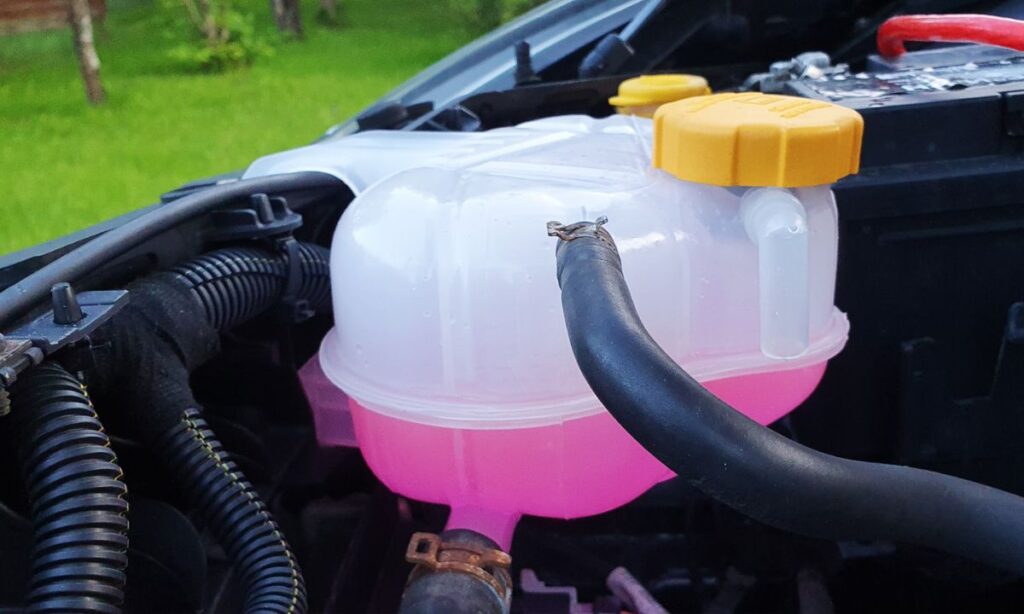
- Colour is typically pink, red, or orange depending on the brand — not green
- Pre-mixed 50/50 or concentrate mixed with distilled water — never tap water
- Do not mix with green IAT coolant — incompatible chemistry causes sludge and accelerated corrosion
- If existing coolant type is unknown, flush the system completely before refilling
Capacity by Model
- Dashing 1.5T and 1.6T — approximately 5.5–6.0 litres including the heater core
- X70 Plus 1.5T — approximately 6.0–6.5 litres including the heater core and overflow reservoir
- T2 2.0T — approximately 7.0–7.5 litres
- Dashing PHEV — two separate cooling circuits: petrol engine circuit approximately 5.0 litres, electric motor and battery thermal management circuit approximately 3.0 litres. Both circuits use OAT coolant. Check both reservoirs independently — they have separate filler points.
PHEV Cooling Circuit — Two Systems
The Dashing PHEV has a dedicated electric drive cooling loop separate from the combustion engine circuit. The electric motor, inverter, and battery thermal management system all share this second circuit. Both circuits require OAT coolant of the same specification. The electric drive reservoir is typically located near the high-voltage battery area and is distinctly labelled — filling it with the engine coolant instead, or vice versa, dilutes the correct fill level in each system and triggers low coolant warnings.
What to Look for on the Label
When purchasing coolant for any Jetour model, check the label for:
- OAT designation — must appear explicitly, not just ASTM D3306 alone
- Phosphate-free and silicate-free statements
- Ethylene glycol base — not propylene glycol, which has lower heat transfer efficiency and is not the factory-specified fluid
Brands with OAT coolant suitable for Chery/Jetour engines include Zerex Asian Vehicle, Motul Inugel Optimal Ultra, and Ravenol OTC. Always verify the specific product meets OAT requirements rather than relying on the brand name alone, as product lines vary.
Mixing Ratio and Change Intervals
The standard pre-mix ratio is 50/50 concentrate to distilled water, providing freeze protection to approximately −35°C and adequate boil-over protection. In warm-climate markets like South Africa and the UAE where freezing is not a concern, a 40/60 ratio is sometimes used, but the factory recommendation is 50/50 and this should be the default.
Change intervals for Jetour models align with Chery’s standard:
- Petrol engine cooling circuit — every 4 years or 80,000 km, whichever comes first
- PHEV electric drive circuit — same interval, serviced at the same time
If the coolant in the reservoir appears brown, has visible sediment, or shows an oily film on the surface, replace it immediately regardless of the service interval. These signs indicate either an incompatible fluid was previously used or internal corrosion is occurring.