Lexus Coolant Type: LLC, Super Long Life, and What Not to Mix
Lexus uses Toyota-developed coolant formulations, and the correct type depends on when the vehicle was built. Since 2004, all Lexus models have used Toyota Super Long Life Coolant — a pink, pre-mixed HOAT formulation with a 100,000-mile initial service interval. However, older models used the red Toyota Long Life Coolant, which requires dilution and has a shorter change interval. Because mixing the two types causes a chemical reaction that produces gel-like deposits, identifying which type is currently in your vehicle matters before adding or replacing coolant.
Toyota Super Long Life Coolant (2004 and Newer)
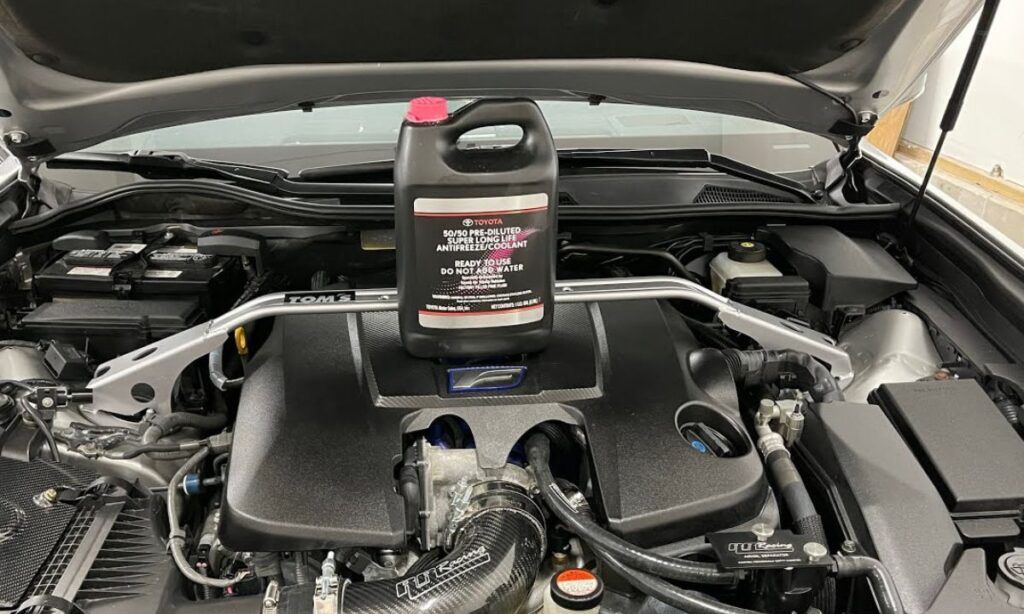
All Lexus models from 2004 onward — including the IS, GS, ES, RX, NX, UX, GX, LX, LC, and LS — use Toyota Super Long Life Coolant (SLLC). It is pink in colour and comes pre-mixed 50/50 with distilled water. Therefore, you do not need to dilute it before adding it to the reservoir.
The specification is HOAT (Hybrid Organic Acid Technology) — it contains both organic acid inhibitors and phosphate additives specifically formulated for Toyota and Lexus aluminium alloy cooling systems. The correct type must be:
- Ethylene glycol-based
- Silicate-free, amine-free, nitrite-free, and borate-free
- Pre-mixed or concentrate mixed with distilled water — never tap water
- Pink or red in colour if using Toyota/Lexus OEM product
Suitable aftermarket alternatives include Zerex Asian Vehicle (red or pink), Prestone Extended Life for Asian Vehicles, and Pentosin Pentofrost A4. However, any aftermarket product must explicitly state compatibility with Toyota/Lexus HOAT specifications — generic green or blue IAT coolants are incompatible and cause corrosion in Lexus cooling systems.
Toyota Long Life Coolant (Pre-2004 Models)
Older Lexus vehicles built before 2004 — including earlier IS300, GS300, GS400, SC430, and LS430 models — used Toyota Long Life Coolant (LLC). This coolant is red, concentrated, and therefore requires mixing 50/50 with distilled water before use. The change interval is 30,000 miles or 2 years, significantly shorter than the Super Long Life version.
Although LLC and SLLC are chemically compatible as both are Toyota-developed formulations, mixing them produces an unattractive brown colour and technically reduces the inhibitor effectiveness of the newer coolant. Since most pre-2004 Lexus vehicles are now well into their service life, a complete flush is the correct approach when switching between types rather than topping up with the alternative.
Hybrid Models — Two Separate Cooling Circuits
Lexus hybrid models — including the RX450h, NX450h, UX300h, ES300h, LS500h, and LC500h — have two cooling circuits that operate independently:
- Engine cooling circuit — uses the same Toyota SLLC as standard petrol models
- Inverter and motor cooling circuit — also uses Toyota SLLC, but runs at a lower temperature range
Both circuits share the same coolant specification, however they have separate reservoirs and separate filler points. The inverter coolant reservoir is typically smaller and located near the high-voltage battery or power electronics module. Since the two circuits do not share fluid, a low reading in one reservoir does not affect the other. Check both reservoirs independently at every service.
Capacity by Engine and Model
- 2.0L and 2.5L four-cylinder petrol (IS250, NX250, UX250h) — approximately 6.5–7.0 litres
- 3.5L V6 (RX350, ES350, GX350) — approximately 9.0–9.5 litres
- 5.0L V8 (IS500, RC F, LC500) — approximately 10.0–11.0 litres
- Hybrid inverter circuit (all models) — approximately 3.0–4.0 litres separately
Change Intervals
Toyota Super Long Life Coolant has an initial replacement interval of 100,000 miles, followed by 50,000 miles at each subsequent change. However, many independent Lexus specialists recommend a 5-year interval regardless of mileage, since coolant condition deteriorates with heat cycles over time even when the odometer reading remains low.
If the coolant in the reservoir appears brown, shows sediment, or has an oily film on the surface, replace it immediately regardless of the service interval. Brown coolant indicates either an incompatible fluid having been introduced, or early signs of internal corrosion or a head gasket seepage that requires investigation before it causes further damage.